What Regulations for the New Religious Movements in the European Union?
CICNS · 1 August 2011
“What Regulations for the New Religious Movements and Dérives Sectaires in the European Union?”
A CICNS reading report (August 2011)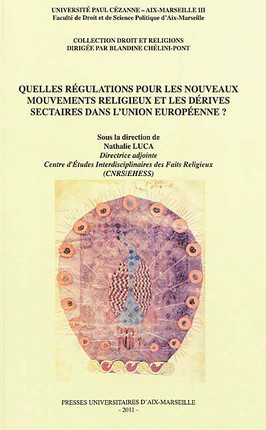
The collection Droit et Religions, directed by Blandine Chélini-Pont, has just published the proceedings of a colloquium entitled: “What regulations for the new religious movements and dérives sectaires in the European Union?”, edited by
Nathalie Luca. CICNS was present at this seminar, on which we published a
report in January 2010. Everyone wishing to understand the way certain European countries treat the question of the “cults” is invited to read this work, notably following the delivery of the latest
We reproduce below extracts from this work, and notably from the debates that followed each session.
Jean-Paul Willaime (Director of studies at the EPHE, Director of the IESR) - Europe and Religions
”(…) The question of the cults is not a specifically religious problem, but a question arising from the general respect of human rights and of personal and public liberties in all social activities (religious, but also associative, sporting, economic, trade-union, political, educational, media…). But it is true that the question of the cults is in fact linked to that of religion, and that some, considering it a typical excess of all religions, have even found in it something to nourish their traditional reserve towards religion. Personally, I have always approached these questions on the basis of this fourfold observation: 1) every religious movement, whether old or new, socially recognised or socially disqualified, is liable, in certain circumstances, to know dérives sectaires; 2) this type of excess, where collective pressure and subjection to an authority infringe the fundamental liberties of the individual, can nevertheless, beyond religious activities, occur in every social activity implying relations of subordination; 3) in democratic societies, founded on respect for the laws and human rights, there is a general right to non-conformism, democracy not meaning the uniformisation of behaviours and ways of life, even if there are tendencies in that direction; 4) it is entirely normal that the public authorities concern themselves with these questions and give themselves the means, in respect of public liberties, to protect their nationals against practices calling their own liberty into question.”
“It is easier to adopt a single currency than to envisage, supposing it were desirable (which is far from obvious), a European harmonisation of Religion-State relations! (…) The Treaty of Lisbon, in force since 1 December 2009, indicates it clearly in the first paragraph of article 17: ‘the Union respects and does not prejudge the status enjoyed, by virtue of national law, by the churches and religious associations or communities in the Member States’. In its second paragraph, which was particularly supported by Belgium, this principle of the Union’s respect for national provisions is extended to philosophical and non-confessional organisations: ‘The Union equally respects the status enjoyed, by virtue of national law, by philosophical and non-confessional organisations’. But the EU goes further with paragraph 3 of the same article, which reads: ‘Recognising their identity and their specific contribution, the Union maintains an open, transparent and regular dialogue with these churches and organisations’. (…) Without being able to develop this point here, we would say that the EU implicitly recognises the sociological specificity of religious and philosophical groupings as groupings embodying diverse conceptions of man and the world and representing, for their followers, convictional, identity and ethical resources. Secondly, the EU, by declaring that it maintains ‘an open, transparent and regular dialogue with these churches and organisations’, recognises the representatives of the religions and humanist philosophies as valid interlocutors worthy of a regular dialogue.”
Nathalie Luca (Deputy director of the CEIFR (CNRS/EHESS)) - Europe facing the cults
”(…) All these disturbing groups have one point in common. In all the suspected cases, the credo is supposed to dictate the behaviour of the faithful in every sphere of activity. It is this very thing that creates tensions, and it is by reason of these tensions that they finally appear as ‘cults’, that is to say as small, socially non-assimilated organs (for the size of the movement plays a part in the possibility of labelling it a cult), in certain of the national and European reports published since the 1980s. All these reports underline the urgency of a deepened reflection on this problem, capable of allowing the examination of legal lacunae and leading to the creation of an assistance service, as well as the necessity of implementing a preventive policy, to prevent, precisely, these movements from developing further among Europeans. It seems important, in effect, to insist on the fact that a group is stigmatised as a cult only from the moment it touches and converts Europeans.”
”(…) The European Parliament devotes a new document to the cults on 11 December 1997[1]. Without calling into question the vigilance the development of these ill-known movements imposes on the States, it nevertheless takes a higher view of the phenomenon. It concludes notably that nothing, at present, imposes or justifies the putting in place of a European policy against the cults. The Council of Europe in its turn opens a new session on this theme on 22 June 1999[2]. The responsibility of ‘the State and [of the] public authorities [which] cannot renounce their task of prevention and surveillance’ is reaffirmed. The document even proposes the creation of a ‘European observatory of groups of a religious, esoteric or spiritual character’. It will never see the light of day. The approved text leaves aside all the polemical elements present in the discussions, such as the reflection on ‘mental manipulation’ or the additional measures to be taken to ensure better the judicial prosecution of delinquent groups. The Council of Europe finally chooses to remain in the background so as not to arouse confrontation within itself.”
”(…) Certain national reports in their turn manifest reservations about the policy to be conducted against the cults. That is not the case of France: it creates the MILS (Interministerial mission for the fight against the cults) in 1999, a title which by itself underlines the offensive will presiding over its establishment. (…) But the proposals of a great part of the other Western European countries follow the continuity of those of the Council of Europe and in fact display a hostility to firmer approaches. French-speaking Switzerland had been directly touched by the affair of the suicides of the Order of the Solar Temple, which had mobilised the political class on the questions of the cults. A commission of experts is first charged with carrying out an ‘audit on dérives sectaires’. It is published in February 1997 and its conclusions urge Switzerland to create a structure similar to that of the MILS and to reflect on new laws. Yet it is in an altogether different, far more moderate direction that it finally orients itself. In 2002 is created the Centre d’Information sur les Croyances (CIC). At the initiative of several cantons. The title alone is an answer to the French policy of fighting the cults. (…) Germany, as we have seen, was the first to worry about the ‘cults’ in its 1980 report. From 1993, it puts in place a new department called ‘youth sects and psychogroups’. Its role is close to that of the MILS, though it is attached only to the ministry of youth and the family. (…) Yet the report of the commission of inquiry of the federal parliament, presented in June 1998, is much more moderate and undertakes a visible effort of explanation[3]. From the introduction, the president of the commission, Ortrun Schätzle, specifies her attachment to article 4 of the German Constitution – stipulating the principles of neutrality and tolerance of the Government - as well as to the freedoms of religion, conscience and belief, inalienable elements of human rights. She adds that this report was largely guided by the will to fight against the stigmatisation of certain groups and, consequently, against the use of the term ‘sect’, bearer of too negative connotations. For the same reason, the report opposes the publication of a list of groups active in the Federal Republic of Germany, ‘because such a list carries the considerable risk that the groups mentioned will be stigmatised’.”
”(…) Belgium, on the other hand, attempts, like France, to put in place a policy of prevention. A Centre of Information and Advice on Harmful Sectarian Organisations (CIAOSN) and an administrative Cell for coordinating the fight against the organisations are created, linked to the ministry of justice, by a law of 2 June 1998. One should not conclude from this that France and Belgium maintain a frank complicity in the management of the cult phenomenon. The comparison between the two countries reveals that the CIAOSN attaches more importance than the MILS (then the MIVILUDES) to achieving a balance between police, political and academic sources.” (…) But many countries of Europe have not created a specific state body to answer the public’s questions concerning these ‘groups of a religious, esoteric or spiritual character’. (…) Great Britain is, in this landscape, a somewhat separate case since, while there does exist a centre of information on religious movements, INFORM (Information Network Focus on Religious Movements), it is a university institute, certainly financed by the State and the Anglican Church, but perfectly independent. (…) Sweden, doubtless the most extreme case, rid itself in 2000 of its State religion (the Lutheran Church) and created in the process a legal status open to all religious organisations that request it.”
Louis-Léon Christians (Professor at the Catholic University of Louvain) - Public information policies facing dérives sectaires
”(…) Attached to a high guarantee of freedom of expression, the case law of the Court [CICNS: ECHR] has not failed to record the necessarily polemical nature of the debates concerning the ‘cults’ and dérives sectaires. (…) It follows that a high level of excess and outrance of statements must be admitted in the framework of the debates on the ‘cults’. This approach is further reinforced by various rulings which hold that the invective ‘cult’ must be considered a value judgement and not a judgement of fact[4]. The Court thus confirms the absence of objectivity of the qualification of cult, but it paradoxically follows, by the criteria of the case law, that this concept must benefit from the freest use, without extensive demonstration of determining proof.
”(…) The Court has not yet had occasion, to our knowledge, to return explicitly to the necessity of a reinforced adversarial approach when the information procedure emanates from the public authorities, for the information to be diffused, mentioned by recommendation 1412/1999, that is to say on its free discussion with the groups concerned, by way of a sort of right of defence from the documentary phase onward.”
”(…) If one attempts an assessment of the case law relating to the expressive functions of the State, one will retain that the specific intervention of the State is not only admitted but legitimate, and that it is perhaps also necessary by way of the horizontal protection of human rights. At first sight, on the plane of affirmations of principle, this intervention of the State in public debate is subject to particularly high requirements. It does not in any case benefit from the same liberties, notably polemical ones, as those of the other participants. The State is bound by a particular obligation of neutrality and objectivity. It must perhaps submit its information to the adversarial evaluation of the groups targeted. It must in any case guard its action against any aim of agitation or indoctrination. On the other hand, when the test of the negative consequences of these means of information arrives, and the proof of a causal link between this information and hindrances to the tranquillity of these groupings, notably in the exercise of their freedom of religion, one seems to observe a far less responsibilising approach to the State. Indeed, in a fairly recurrent way, the Court seems to deny public information policies any measurable and identifiable effect, sometimes de facto, sometimes de iure.”
First session: the French model
Patrice Rolland (Professor at the University Paris XII) - Introduction
”(…) France has known roughly the same religious movements or cults as the rest of the Western world. This last reason contributes, moreover, to bringing out the particularity of the French reaction and treatment. Scientology and the Jehovah’s Witnesses have not been equally stigmatised in all the European countries. The French particularity thus resides above all in the reaction with which French society and the State received them. The reaction of the media, the political class and, to a much lesser degree, the Administration and the Justice system was appreciably more visible, stronger and more anxious than in the rest of Europe, and a fortiori than in the United States.”
”(…) How can a State founded on the principle of ‘non-recognition of religions’ of article 2 of the 1905 law define the notion of religion, a preliminary to the definition of that of the cults? (…) It is concretely fundamental to know the definition and outline of a notion, for example that of the ‘cult’, intended to found a policy of prevention and a fortiori a policy of repression. (…) The subjectivism of the believer or the believing community is inescapable, by reason of the rights of individual conscience and religious liberty. The State, to form its judgement, can find facing this individual self-evidence only a failing objectivity: the deregulation of the religious tends to make disappear the traditional bearings allowing a religious practice or thought to be qualified. It is here that French laïcité is probably caught in an embarrassment of its own. (…) The Court [ECHR] does not hesitate to define religion, but it does so very broadly and almost formally. The notion of religion is, in practice, brought close to that of conviction, but the latter must, moreover, correspond to ‘a coherent vision on fundamental problems’[5]. It is necessary, in the second place, that the individual’s practice have a link with the religious community he claims. The latter must be able to attest, implicitly or explicitly, to the link of this practice with the way in which the community of believers conceives and regulates its religious practices. It is thus legitimate to address oneself, where they exist, to the religious authorities. To which ‘recognised’ community can the secular French Republic turn to regulate the choices of individual subjectivity and religious practices?”
”(…) In a secular State practising Separation, the public order which applies to the cults must be of the same nature as that which holds for the other religions and convictions; and, moreover, more generally it must be conceived in the same way for all liberties. On various occasions, there has been the temptation to impose on the cults respect for a public order understood more broadly and, thereby, more demandingly. There was invoked, for example, a ‘social public order’ exceeding the traditionally material conception of public order in the domain of administrative policing.”
Amélie Cladière (Secretary general of the MIVILUDES)
”(…) To answer its missions, the MIVILUDES uses neither list nor discrimination grid for the movements and practices submitted to its examination, and recalls at every opportunity to the agents of the State who solicit it that such an approach is to be proscribed.”
”(…) Nor does it interest itself in the content of convictions as such. It is of course its responsibility to study it, to attempt to understand its internal coherence and to evaluate its import when it must pronounce on the dangers inherent in the teaching or the very practice of convictions, as for example concerning educational theories carrying dangers for the security or development of children. But beyond this evaluation through the prism of the requirements of security, physical and mental integrity and public order, it does not interest itself in the content of convictions.”
”(…) Nor does it found itself on the ‘recognition’, the established or non-established, majority or minority character of the movements studied, nor on the point of knowing whether there exists a content that can be qualified as religious or convictional.”
”(…) The MIVILUDES takes part moreover in the fight against all forms of discrimination conducted by the public authorities, by recalling to the agents of the State their obligations in the matter, on the occasion of consultations and training actions.”
Bertrand Gaume (Head of the central Bureau of religions) - Religious liberty and its limits posed by the law and by case law
”(…) ‘The State recognises no religion’ (…), what does that mean? It means simply and solely that there is no concordat or organic articles. So there is no system of legal recognition in the Austrian or Spanish manner. Doubtless one may think that there nevertheless exist forms of social recognition. Indeed, recognition is not only legal, it is also social, societal, media-based. The fact that certain religions are invited to official ceremonies while others are not, is that not a form of ‘recognition’?”
”(…) Experience has shown that an approach consisting, for the public authorities, in qualifying this or that grouping as a ‘cult’, or in founding their action on this qualification alone, does not make it possible to ensure effectively this reconciliation between respect for public liberties, respect for the principle of laïcité and the fight against a certain number of doings.”
”(…) the legal arsenal serves, from the point of view of the Ministry of the Interior, to fight against groupings which disregard public order. And of groupings which disregard public order, there are many. Some of them sometimes have nothing to do with religious movements, though the sociologists or psychologists might ponder certain springs which consist, for groups of football club supporters for example, in not watching the football matches, in gathering in small numbers, in having closed-circle behaviours, and in expressing sometimes radical opinions.”
”(…) It is important to retain here the constant of the Ministry of the Interior: the container matters little, only the content counts. A rape, whatever the deep conviction of the person committing it, is a rape. A fraud is a fraud. An abuse of weakness is an abuse of weakness. That is the essential. These are acts which must be repressed, before everything, more than everything and irreducibly.”
Debate on the French situation
Q - A member of the CICNS association (Centre d’Information et de Conseil des Nouvelles Spiritualités): “I think there are many comments to make on the notion in France of cults and dérives sectaires. I am going to put a very concrete question to Mme Cladière. Since you mentioned your attachment to freedom of conscience and the fight against discrimination at the end of your intervention, how do you reconcile your affirmation with the descent of the MIVILUDES into the community of the Moulin des Vallées? The term ‘descent’ is not mine; it is the term borrowed from the press which described this operation, and I confirm to you that the people who underwent this descent lived it like that, in a very traumatising way. To explain a little, for the people in the room, what I call a descent is the fact that M. Fenech, president of the MIVILUDES, accompanied by ten or a dozen people, arrives unannounced in a community of people who are not aware, takes each of these people one by one, questions them on who they are, what they do, why they do it, how they educate their children, what they eat, etc. Georges Fenech was also accompanied by journalists; France 2 and Le Parisien were there. That is my question.”
(…)
A - Amélie Cladière: “You will excuse me if I have not quite understood the link between the fight against discrimination and what you call, or the press, perhaps, I have not seen that word, but possibly called, the ‘descent’, which is a visit by the president to a community. You will excuse me if I do not answer your question exactly. I shall answer on the president’s visit to the Moulin des Vallées and you will see whether it also answers the question on discrimination. I confess I do not really see the link. The current president of the MIVILUDES is a magistrate by training. He has his own culture as a magistrate, and he travels. It is true that the previous presidents travelled less, though I believe it had already happened before him. In any event, the president travelled because there were a certain number of letters from families, questions from the public authorities on the spot, who had themselves been alerted by their constituents. It was necessary to seek to understand where the problems came from. There were questions about therapeutic practices outside conventional medicine, and about the presence of children etc. It is obviously not a descent, insofar as one knocks at the door and asks the people whether they agree to receive the mission. There is absolutely no constraining dimension, of course. There were not a dozen people from the MIVILUDES, I do not think, at least to my knowledge, and in view of the number of travel authorisations I signed. There was the president and three advisers plus the defender of children. The presence of the journalists - I have neither to congratulate myself on it nor to reprove it, it is really not my subject. What I am explaining to you is that it has nothing coercive about it. The visit to the Moulin des Vallées is then the occasion, and that is finally what is most productive, of also receiving the families of worried people, the associations dealing with this problem, of visiting the Departmental Council of the Ordre des médecins, since in this case it is a rather therapeutic problem, the prefect of course… in short the public authorities on the spot. It is a sort of brainstorming, of putting in synergy the public authorities on the spot, which is at the heart of our mission, but done in the field.”
”(…) How are we informed? To tell the truth, like everyone, except that we spend our time on it, which allows better information than the run of the mill. We are informed like everyone: by the work of the researchers; by what the associations of vigilance, of struggle, of defence of whatever you like tell us; by what the movements themselves tell us when they wish to write to us, of course; by the press, news items, everything happening in the world, not only in France. (…) We also inform ourselves by travelling, even if that can create emotions, to hear all sides say what they have to say. Nor do we forbid ourselves the testimonies of ex-followers. It is a datum, a datum like any other, but which has its value. (…) I insist a very little on the testimonies of ex-followers because I know it is a contested subject. For my part, I am very at ease with this subject, as you can see.” (…)
Q – Maître Goni: “I am the lawyer of the Christian federation of the Jehovah’s Witnesses in France.” (…) My question is intended for Mme Cladière (…). Notwithstanding the fact that you work a great deal on denunciations, on complaints, you go on the Internet. So here is my question: what are the procedural guarantees you can offer as an interministerial institution? M. Fenech may well be a former magistrate, but he is no longer a magistrate, and when he makes a visit he does not have the prerogatives of a magistrate under a rogatory commission. So my question is: what guarantees do you offer to re-establish the adversarial principle? (…) The rule is as follows: one runs up against a refusal of communication from your administration, the MIVILUDES, systematically, when one requests a right of access to the documents you use.”
Q- Patrice Rolland: ”(…) It seems to me that what currently makes the unity of the action of the MIVILUDES, which is no longer directly religious, though it was very strongly so at the beginning, that must not be denied, is the idea of mental hold in religious matters, in psychological matters, etc. I wanted to know your opinion on that, whether it accounts well for the true unity of the notion of dérive sectaire?”
A- Amélie Cladière: ”(…) First, concerning M. Goni’s question (…). In reality it concerns the CADA and the rules of communication of administrative documents. (…) It is possible that the CADA has pronounced on documents of the MIVILUDES, but there you are, these are general rules which apply to all in the matter of communication of administrative documents.
(…) As concerns your question, M. Rolland, it is not false to say that what could underlie all these notions is the notion of hold. It is the notion of infringement of individual liberty, and the whole debate is there. Because after all one can sacrifice one’s life, sacrifice one’s goods, sacrifice one’s family ties, sacrifice one’s physical and mental integrity - well, that of one’s children is already much more debatable - on condition that one is perfectly free to do so. So indeed the question of hold is just behind.”
CICNS commentary, outside the colloquium and following the re-reading of the minutes of the interventions of Amélie Cladière, secretary general of the MIVILUDES:
“The MIVILUDES uses neither list nor discrimination grid for the movements and practices submitted to its examination”: this is a mode of argument privileged by the MIVILUDES: claiming not to do something the better to do it.
”(…) The MIVILUDES takes part moreover in the fight against all forms of discrimination conducted by the public authorities”: this is probably what one might name “the height of hypocrisy for the principal anti-cult body in France”.
“Nor do we forbid ourselves the testimonies of ex-followers”: this euphemisation of the MIVILUDES’s privileged method of information is not far from a form of cynicism; as is claiming to inform oneself from recognised researchers, since their work is totally neglected.
“The current president of the MIVILUDES is a magistrate by training”: Georges Fenech having been an investigating judge, he does indeed have the inquisitorial reflex, but let us recall that in his position as president of the MIVILUDES, his rank as magistrate is off topic and should not be referred to (as Maître Goni very rightly pointed out in his question).
“I confess I do not really see the link between the fight against discrimination and what you call (…) the descent”: That is no surprise; the MIVILUDES applies itself to ignoring the discriminatory effects of its action, having made the choice of the “good victims” versus the “bad victims”.
“It was necessary to seek to understand where the problems came from [community of the Moulin des Vallées]”: What problems? Could the problem not be that the letters or questions of the constituents are unfounded? Or more exactly explicable by the campaign of discredit and all-out suspicion launched by the MIVILUDES against all the spiritual, therapeutic and educational minorities?
“There is absolutely no constraining dimension, of course [for the Moulin des Vallées, in accepting the intrusion of the MIVILUDES]”: Yes there is: when a senior official claims the authority of the Prime Minister, with a dozen people accompanying him, to enter people’s homes and conduct an inquiry, there is a demonstration of intimidating authority. Doubled with a fine hypocrisy: what would be the reaction of the MIVILUDES if a refusal were opposed to it, when it takes care to surround itself with journalists eager for stories of dangerous ‘cults’?
“The presence of the journalists - I have neither to congratulate myself on it nor to reprove it, it is really not my subject”: Not only is it part of the subject, it is one of the principal axes of the MIVILUDES policy conducted by G. Fenech: mediatising his action to excess. Without the amplification of the media, the unfounded statements of the MIVILUDES would long ago have led to its dissolution. The media serve to provide the complement of malicious gossip the president of the MIVILUDES cannot allow himself to utter (except when he lets himself go).
“That is finally what is most productive, of also receiving the families of worried people”: An illustration in the text of the choice of the “good victims”. The members of the community of the Moulin des Vallées can manage with their trauma; it does not enter the framework of the MIVILUDES’s “brainstorming”.
“Because after all one can sacrifice one’s life, sacrifice one’s goods, sacrifice one’s family ties, sacrifice one’s physical and mental integrity - well, that of one’s children is already much more debatable - on condition that one is perfectly free to do so. So indeed the question of hold is just behind.”: The MIVILUDES is certainly not the place (for lack of competence, methodology and respect for the adversarial principle) for broaching so sensitive a subject, which has no business, in the current state of reflection, in the framework of public action (the place of this reflection is in the research laboratories).
Second session: the Belgian model
Éric Brasseur (Director of the CIAOSN) - The CIAOSN: no prior reading grid
“The Centre of information and advice on harmful sectarian organisations (CIAOSN) is founded by a law - this is a primordial point - the law of 2 June 1998 (…). It is an independent public service (…). Independent - the key word is pronounced: the Centre receives directives neither from the Ministry of Justice, nor from the Administration, nor from anyone.”
”(…) For the application of the present law, a harmful sectarian organisation is understood as any grouping with a philosophical or religious vocation, or claiming to be such, which in its organisation or practice engages in damaging illegal activities, harms individuals or society or infringes human dignity. The harmful character of a sectarian grouping is examined on the basis of the principles contained in the Constitution, the laws, decrees and ordinances and the international conventions safeguarding human rights ratified by Belgium.”
”(…) Allow me to return here to the famous ‘Belgian list of the cults’. There does not exist and there has never existed in Belgium an ‘official list of the cults’. The document which is regularly, and wrongly, considered a ‘list of the cults’ is in fact the synoptic table of the report of the parliamentary commission of inquiry of 1997, a sort of thematic index.”
”(…) It should be underlined that the study service of the CIAOSN works solely from public, dated and adversarial documents which allow the recipients to verify or refute the information transmitted. (…) The study and, in fine, the content of the documents transmitted comprises the history of the grouping, its doctrine, its practice and activities, its publications, ongoing judicial affairs, any case law and, where appropriate, a ‘focus’ on certain points that seem to pose a problem. The study is closed by a bibliography listing all the sources used for the work. As a reminder, the CIAOSN bases itself exclusively on information from open sources available at that moment. The persons who address a request to us about a group with a religious or philosophical vocation receive either a copy of available documents, or a synthesis of the information at our disposal, without any qualitative appreciation of the movement being expressed. These answers, made preferably in writing, make it possible to avoid all misunderstanding and inappropriate interpretation, and to cite the sources used. Which then allows the requester to give complementary or different information, to specify questions, to refute where appropriate.”
”(…) A primordial question naturally bears on the authority of the witness. And we know witnesses are often partisan, whether they be possible victims or members of groups. The pertinence bears also on the witness’s direct access or not to the information.”
Debate on the Belgian situation
Q - Jean-Paul Willaime: “I have a question on the deontology of your approach and the importance, in the collection and analysis of information, where I note that you use a university deontology of the criticism of sources, which is an extremely important element, to construct public information. One gathers different sources but one has a critical reflection on the sources. I observe also that in your work of constituting information, besides the broad openness, of course, of your centre, you also include among your sources the insiders, not only people outside the movement, but also people who are part of the movement, members, ex-members, etc. And that it is the collection of all this information that allows you to have an objectivising approach to the various phenomena in question. I note also the fact that you answer the questions put to you. You do not predetermine them. You answer the questions. There is certainly more social demand for information on religious movements that pose questions, that worry, but that is the state of opinion, and so you work from that.”
Q - Jean Baubérot: “Indeed I too was sensitive to the deontology of the approach, but I pose myself the problem of the tension between what you have set out to us, and the approach you follow, and the very title of your mission, which can all the same create an ambiguity in the mind of the public and can make people think that the groups on which they find documentation form part of the mission as targeted by the title, that is to say harmful sects. So my question concerns the appellation of your mission. That in 1998, after what had happened, this appellation was favourably received can be understood, but now, in 2010, should this title not be questioned?”
A - Éric Brasseur: “This title is questioned; it generates ambiguity, indeed, but it was chosen by the chamber of representatives in a law. This ambiguity arouses a prejudice against us and it is no pleasure. I would prefer another title, and I am not the only one at the CIAOSN to think so. But we all know the risks there are in putting a legislative text back on the workbench: there will be new proposals, other proposals, restrictions on the definition or broadenings of its field of application, etc.; in short, the exercise is not secure! I therefore share your point of view. That said, the fact that our name does not please does not suffice to disqualify our work.”
Q -: “Is it not counterproductive for your work?”
A- Éric Brasseur: “Yes, especially if one attaches exaggerated importance to it.”
Q – CICNS: “Structures that look for harmful things in others - that immediately introduces a bias. As soon as they attend to a group, a suspicion will be emitted with a rumour about someone.”
A – Éric Brasseur: “I know biases exist, but an association which represents a group and itself promotes it is no less biased. So let us not doubt that the public may believe it or want to believe it. But I recall that if there is the word harmful organisation/sect, that means a contrario that a sectarian organisation is not necessarily harmful… One might meditate on that point.”
Q – CICNS: “Let me take an analogy. Suppose one created the agency for the surveillance of dishonest politicians: do you think it would be a body recognised as a good body?”
A - Éric Brasseur: “Monsieur, I quite understand that creating a body on nuclear protection or on the security of passenger transport could lead people to believe there is a problem. I do not find it abnormal that the State attends to the cases that preoccupy its citizens. The vote in the chamber which instituted the CIAOSN is, in essence, democratic.”
Q – CICNS: “Why not create an observatory of the spiritual minorities, which is a positive approach?”
A – Éric Brasseur: “Must I say it again: we are heirs of this title, no more no less. But informing the citizen without a prior reading grid is a positive act.”
Q –: “Could you specify for us what becomes of the information your body will consider harmful - concretely, I mean?”
A – Éric Brasseur: “I never said that our body, in its work of information, considered a movement harmful. I said it at no moment. I said the work consisted in giving information on the movement, and it is for the reader to draw the conclusions he considers he must draw.”
Q—Bertrand Gaume: “Pardon me for confessing my ignorance of international relations, but do you make visits on site and on file like other structures in Europe, that is to say, in plain terms, field visits?”
A – Éric Brasseur: “No, we are not a police service, nor do we have any judicial capacity. I did not say we could not make visits but, in truth, we do not do that type of thing.”
Q -: “In plain terms, we spoke this morning of ‘descents’ in the field. In Belgium you have none?”
A – Éric Brasseur: “I have just answered. Listen, we are an information centre, we do not make ‘descents’, that is clearly said (…).”
(…)
Q – Bertrand Gaume: “How do you take into account the dimension of the causal link between the individual and the group? Let me explain. (…) One or several individuals commit what the law, the Penal Code, calls crimes, and which give rise to case law. In the answer you make, will you say such-and-such a group was the object of X or not? Because there we are at the heart of the link of stigmatisation and discrimination (…).”
A – Éric Brasseur: ”(…) In the work of information we do, we do not indicate a causality between an individual acting as such and any group whatever. If there is a rape committed in the street by someone, it is a rape committed by an individual; the fact that he is a member of a group is a priori unrelated. If it were an organised and voluntary practice, if it were written in the texts that it was fitting to rape, we would take account of it, and we should do so and report the matter to the authorities.”
(…)
CICNS commentary, outside the colloquium and following the re-reading of the minutes of Éric Brasseur’s answers
Éric Brasseur’s answers belong within the blind spots (maintained or unconscious) characterising the French and Belgian anti-cult policies, Belgium unfortunately tending to want to copy France in this domain (see notably the project of an About-Picard-type law in Belgium supported by the CIAOSN).
To consider that the persistence of a degrading terminology (“harmful sect” or not) is a simple question of an overbooked parliamentary agenda constitutes an intellectual deception of the first order. Let us note moreover that the president of the CIAOSN is more preoccupied by the prejudices concerning his organisation than by the prejudices overwhelming all those who are named “cults”. The repetition of these henceforth insulting substantives is not a simple anomaly; it is at the heart of the policy followed in the matter (as the Belgian bill on abuse of weakness demonstrates anew). As for the comparison proposed by Éric Brasseur between his organisation and an organisation of the same type concerning the dangers of nuclear power or the security of passenger transport, it is off topic, for the difference between an action targeting persons and capable of ending in discrimination, and an action targeting an energy or transport policy, ought to appear obvious.
Third session: the Swiss model
François Bellanger (President of the foundation Council of the intercantonal Centre of Information on Beliefs (CIC)), Brigitte Knobel (Director of the CIC) - Information on controversial religious movements in the Swiss context of confessional neutrality
”(…) In May 2002, the CIC opens its doors in Geneva. It takes the form of a private foundation managed by a Council of ten persons. Its budget allows it to engage two academics, a sociologist and a historian of religions, to set up the centre, gather information and elaborate files. If the tragedies of the Order of the Solar Temple and the Audit on dérives sectaires were the triggering elements for the creation of the CIC, the religious and political context of Switzerland largely determines its activities and its methodological approach.”
”(…) The public authorities have drawn up no list of religious groups qualified as ‘cults’. Swiss law makes, in effect, no distinction between a religion and a cult and, for want of objective criteria, the State is not in a position to establish a classification of ‘good’ and ‘bad’ religions.”
”(…) The CIC constitutes files comprising documents from several different sources and disciplines to allow the reader to forge his own opinion on the subject. A file may thus include both apologetic and critical texts. It may contain documents reporting dérives sectaires in the group as well as documents mentioning the discriminations it suffers. On the basis of this documentation, the CIC drafts a report of five to ten pages which summarises the annexed documents, presents their authors, the nature of the document and the context in which they were written. The source of the information is systematically mentioned.”
”(…) When a group has activities in France, the CIC mentions whether or not it figures on the list of the 172 movements catalogued in the French parliamentary report of 1996. The CIC systematically completes this information by warning the public that recourse to this list must be avoided following a decision of the French government[6]. This comment by the CIC proves necessary insofar as the list circulates on the internet and is still often considered by the French-speaking Swiss public as an authoritative document.”
”(…) The CIC is particularly attentive to using a neutral vocabulary. In this optic, it privileges the term ‘member’ rather than ‘follower’, the term ‘lobbying’ rather than ‘infiltration’. Still in this concern for neutrality, the CIC abstains from using the term ‘cult’, pejorative and stigmatising. The term ‘cult’ favours in effect the amalgam between strangeness and dangerousness and tends to underestimate the religious dimension of the controversial groups.”
”(…) The CIC has chosen to privilege a neutral approach to controversial religious questions. This approach does not go without saying. Neutrality makes users react, often hostile to the new religiosities, who would prefer to obtain from the CIC a negative judgement on a group and a more repressive attitude. The CIC regularly has the experience that an approach without value judgement is often assimilated to a favourable opinion. Not taking a position is in effect considered by certain users as a form of tacit support for the controversial groups.”
”(…) Does neutrality allow information centres like the CIC to play a regulating role for the new religious movements? The CIC has been able to observe through its practice that the right to join the religious group of one’s choice, to change group or not to belong to a religious group (article 15 of the Swiss Constitution) is often contested by families, the media and the religious communities themselves. This reaction expresses the difficulty of living and communicating with different beliefs. It also illustrates the embarrassment aroused by the new religious alternatives which call into question the monopoly of the historic Churches. The information centres, situated precisely at the crossroads between the worries of the population, the questions of professional circles and the preoccupations of religious organisations, can from then on play a regulating role by circulating information, by recalling to each the legal framework and by favouring dialogue. The experience of the CIC also teaches us that information centres can fulfil a role of ‘guard-rail’ against possible dérives sectaires. However, this role is in our view possible only on condition that these bodies do not intervene in conflicts, can establish relations of confidence with the controversial groups, and are supported by the public authorities. In this perspective, the information centres can be a tool complementary to the existing legal arsenal and represent an innovative form of social regulation of the new religious movements.”
[CICNS: note the definition of the “dérive sectaire” used by the CIC: “an act, an action, physical or psychic, for ends contrary to the law, committed in relation with a belief”; this definition is ambiguous since it supposes, without proof provided, that acts or actions contrary to the law committed in relation with a belief would have springs and consequences distinct from those committed outside the context of a belief (for otherwise why distinguish them?), if indeed one can circumscribe a human domain outside all belief.]
Debate on the Swiss model
Q— Éric Brasseur: “How do you manage to have neutral documentation?”
A – Brigitte Knobel: “The documentation itself is not neutral. In a file, there are several different points of view. There may be documentation underlining problematic aspects of the group, but there may be, in the same file, documentation underlining the discrimination that group suffers.”
Q – Éric Brasseur: “Neutrality consisting in putting the active column and the passive column?”
A – Brigitte Knobel: “No. We refer the public to the whole of the documentation existing on the movement, which allows one to evaluate whether there are dangers or not, but we ourselves do not answer that. Neutrality consists for us in abstaining from taking part in the controversies frequent in this domain.”
A – François Bellanger: “There exist different ways of apprehending neutrality. The first would be to say: we must produce a completely independent report comprising exclusively a neutral scientific analysis. That is conceivable. We do not however have the resources to do it. The other approach, which we have adopted, is to consider the reader of our opinions as a responsible person able to construct his own opinion on the basis of the information we provide him (…).”
(…)
Q – Jean Baubérot: “There has been much talk this morning, in particular with Belgium and with you, indeed, of the plurality of information as a source of objectivation. I totally agree. But you said it well when you underlined that the press, for example, demanded the sensational… But also, to be able to form one’s opinion in a somewhat enlightened way, in knowledge of the facts, one must know how to hierarchise information. And how to do so without being directive, without giving ready-made thinking? (…)”
A – Brigitte Knobel: “One does it above all, and more easily, in the telephone conversations we have with the people who call us, whether relatives, journalists, teachers or members of religious groups. For example one tries to make them attentive to questions, to particular themes. (…)”
(…)
Fourth session: Great Britain
Eileen Barker (Professor at the London School of Economics, founder of Inform) – Inform: A British cult/sect observation group (in English in the volume - CICNS translation)
”(…) Unlike the situation in many other European countries, there is no legal definition or official registration of religions in England. (…) Although they do not have the possibility of being officially registered, religions can apply for charitable status, which can result in obtaining certain tax advantages. For several centuries it was sufficient to demonstrate that an organisation was religious (though the definition of ‘religious’ is not completely clear) to obtain this status, but since the 2006 Act on charitable status, religious charitable groups, like other charitable groups, are enjoined to explain how their objectives benefit the public. Just as there are no laws specifically targeting religious minorities or types of religion, there have been no inquiries or written reports, governmental or parliamentary, on religious minorities in Great Britain, unlike countries such as France, Belgium, Germany, Sweden or the Netherlands. The British government does however support Inform, one among many cult/sect observation groups, which operates independently of all governmental control.”
”(…) Disinformation about the movements sometimes originates with the movements themselves and sometimes with their opponents, but it is the mass media that have been the principal vector of diffusion of sensational and often distorted stories about unusual and bizarre groups. It is, after all, in the interest of the media to attract and capture readers, listeners, viewers, and the non-sensational accounts produced by researchers in the social sciences, with their pedantic diplomas and footnotes, do not answer such objectives.”
”(…) Another frequently used concept which has had the effect of obscuring and misleading more than of enlightening is that of ‘brainwashing’. It is, evidently, a metaphor more than a scientific term. The people using it more probably express their disapproval of the final result (‘unbelievable beliefs’ and/or ‘incomprehensible behaviours’) than the process leading to that result. It is equally possible that this concept is used to discharge the individual and charge the group with the responsibility for this unacceptable result. We do not deny the fact that the result may not be to our liking, but we suggest it is more useful to understand how the convert (or recruit) was led to join the group than to proclaim he was brainwashed.”
”(…) Another error encouraged by the way the media cover these movements is the hypothesis that a conduct of a particular type brought to our attention is typical of the movement but not of the rest of society. If, for example, someone learns in the media that on three distinct occasions members of a movement committed suicide, he will possibly begin to wonder what, in that movement, pushes people to suicide. That person, however, will forget that the media will probably make no report if a Catholic commits suicide – the story would not be worth it. The researcher in the social sciences, for his part, will want to compare the suicide rate in the movement in question with that observed in the general population, and might well find that the latter is twice as high as the former. One might then ask what in that movement prevents people from committing suicide. Of course, there may be numerous reasons, having very little to do with the movement one way or the other, responsible for the difference in the suicide rate, but at least it would no longer be supposed that this visibility of the facts reflects a specificity.”
Debate on the British model
(…)
Q – Jean-Paul Willaime: “Does Inform have influence at the European level? Do you have relations with the European Council in Brussels? What is Inform’s impact at the European level?”
A – Eileen Barker: “Not as much as I would like. There was a time, before FECRIS was formed. And FECRIS wants nothing to do with us because they say we are cult defenders. But there was a time when I was asked to do something at that level (…)”
(…)
Fifth session: the Italian and Spanish models
Jean Baubérot (Emeritus director of studies at the EPHE) - Introduction
”(…) I shall start from an observation made to me by a senior official of the Spanish ministry of justice, since it is that ministry which is in charge of religions. He told me: ‘It is all the same a little astonishing: we have the same problems as you in the matter of NRMs, neither fewer nor more, and we treat them in a rational manner, whereas you treat them in an emotional manner.’”
Marco Ventura (Professor at the University of Siena) – The new religious movements: an invisible category in so-called Christian Italy
”(…) The Catholic Church having the right to a specific recognition and a more favourable treatment, all the other religions without distinction are absorbed into the category of ‘religions other than Catholicism’. (…) A first grouping includes the religions that have not obtained or requested a specific legal recognition: these religions enjoy the fundamental constitutional liberties (…). A second grouping comprises the recognised religions enjoying the status provided by law no. 1159 of 1929 (…). These religions have access to the recognition of ministers of religion as well as of the civil effects of religious marriages. The law provides no tax advantage in their favour. Finally, a third grouping is represented by the recognised religions that have signed an agreement, an understanding (intesa) with the State (…) and which benefit from additional advantages (notably in the fiscal domain).”
”(…) in 1998 (…) the Ministry of the Interior establishes a Report on the sects whose constitutionality was questioned[7]. (…) in 2009 the initiative is taken by the same ministry for a census of ‘religious realities’. In the same furrow, on 4 March 2004 a bill of the Berlusconi government was approved by the Justice Commission of the Senate introducing into the penal code the offence of mental manipulation. The bill subsequently failed, notably for fear that the new offence would be applied to the Catholic Church[8].”
”(…) It is thanks to the Buddhist Union and to Scientology, notably, that Italian case law arrived at a more dynamic and less ‘Christian’ notion of religion. Indeed, in the decision of the Court of Cassation of 22 May 1995 no. 5838 on Scientology, a new definition of religion was applied on the basis of the group’s own statutory self-qualification, of the existence of any prior public recognition and, above all, of the Comune considerazione, namely common opinion.”
”(…) The Italian history of the Soka Gakkai also represents an example of a creative use of Italian religious law revealing its opportunities and impasses. Following the description in very negative terms of the Soka Gakkai in the report of the Ministry of the Interior of 1998, there was constituted, in March 1998, the Istituto Buddista Italiano Soka Gakkai, in order to put in place a strategy of adaptation to the system and to reassure public opinion and the public actors. In November 2000 the institute was recognised by Decree of the President of the Republic, and in 2001 it began negotiations with the government with a view to an understanding.”
Juan Ferreiro Galguera (Ministry of Justice, Professor of ecclesiastical Law at the University of A Coruña) – Spain’s attitude
”(…) One can deduce from the Spanish Constitution that the public authorities are neither confessional, nor atheist, nor secularist, but secular: they are quite simply neutral. We would like to point out that there exists a difference between a secular State and a secularist State. A secularist State maintains a prejudice against the religions and treats them worse than the other groups (cultural, sporting, animal-lovers’ associations…). (…) this constitutional formulation, which combines the secularity of the State and the principle of cooperation, is the result of a pact between the partisans of the Catholic confessional State and those who wanted a more rigid separation ‘in the French manner’. From this drafting, several deductions impose themselves. For example, that the Constitution has a favourable conception of the religious phenomenon (seen as a social factor) or, at least, that the religions have something potentially positive (for, obviously, if it had an unfavourable conception of religious groups, the State would not cooperate with them). To remain in accord with the principle of liberty, cooperation must take place at the request of the confession.”
”(…) one can classify four categories of confessions according to the legal effects they enjoy: 1) Unregistered confessions. Every religious group is the holder of the fundamental right to religious liberty, even that of not being registered. 2) Confessions registered in the Register of Religious Entities (RER). 3) Confessions registered in the RER and having obtained the declaration of notorious rootedness (‘notorio arraigo’). 4) Confessions registered with ‘notorio arraigo’ having signed Cooperation agreements with the State (the case of the Catholic Church, which has obtained in addition a special status through the content of the Agreements forming the object of international Treaties [CICNS: with the Vatican considered a State in this case]).”
Debate on the Italian and Spanish models
Q -: “Hello, I am from the Church of Scientology; that is not the subject of my question in fact. Through all these examples, and through the fact that one sees France trying to export its model - there is indeed a displayed intention of the MIVILUDES to export its model at the European level -, I would like to know whether there is a chance it will succeed, knowing that FECRIS is already a body financed at least 90% by the French government. What is the position of people in Europe with regard to this French will to export a model which is all the same fairly intolerant towards NRMs?”
A – Marco Ventura: ”(…) the great limit of the French model of the MIVILUDES, or its great chance perhaps, is the isolation of the religious phenomenon from the whole of the social phenomenon. When there was talk of the notion of hold this morning, what astonished me is that one can apply the notion of brainwashing, of psychological suggestion etc., solely to this small part of society while completely forgetting the financial markets, the relationship with the banks, advertising, consumer society as a whole. (…) One sees very well, if one takes the phenomenon as a whole, the need for public investment on the question of hold. But I believe that if one wants to be serious, the intervention on hold must not be limited to religion and to the small religions. Now if one goes down that path, the approach of the MIVILUDES will be less and less exportable and less and less important. On the other hand, precisely because hold is becoming more and more a social fact, if the elaboration on hold is freed from this monomania of the cults and broadens to society as a whole, then yes, the MIVILUDES model will have chances of being exported.”
(…)
A – Amélie Cladière: “I have no import-export diploma. I want to specify that the MIVILUDES wants to export nothing. If someone thought they understood that in my talk this morning, they were mistaken. What we wish is to break France’s isolation, by establishing a dialogue, and first a European dialogue. But the Anglo-Saxon world also interests us. (…) We wish to export nothing. Each model is respectable. (…) what we wish and ask again (…) is a dialogue at the European level on all these public policies, for even if there is no public body in most of the countries concerned, there are all the same public policies in the matter.”
Conclusion
Jean Baubérot: ”(…) Thus the final, somewhat disturbing question I would like to pose in conclusion is the following: in these NRMs, including in aspects that shock us, in what troubles us, are there not paths that the future will indicate as being among those that allowed society to move, to transform itself; those that finally allowed society to be alive, not to remain a closed whole? For a closed whole is the end of history, and the end of history is the death of societies. Let us remain at once vigilant in the face of the unacceptable, but let us remain very open to social contestation, for social contestation is also the ferment of the future.”[1] Report of Mme Berger on the sects in the European Union. Commission on public liberties and internal affairs, doc-FR/RR/341/341974, 11 December 1997.[2] Nastase resolution at the Council of Europe, on the sects. 13/4/99. Document 8373.[3]
Final Report of the enquete commission on “so-called Sects and Psychogroups”. New Religious and Ideological Communities and Psychogroups in the Federal Republic of Germany, Deutscher Bundestag, Referat Öffentlichkeitsarbeit, Bonn, 1998.[4] ECHR ruling of 22 December 2005, Paturel v. France. “If the materiality of [declarations of fact] can be proved, [value judgements] do not lend themselves to a demonstration of their exactitude. For value judgements, the obligation of proof is thus impossible to fulfil and infringes freedom of opinion itself, a fundamental element of the right guaranteed by article 10,” states the Court, referring to a case bearing precisely on a polemic in cult matters (Jerusalem v. Austria, no. 26958/95, §42, ECHR 2001-II), while admitting that “a value judgement totally devoid of factual basis may prove excessive”. These weighings between facts and values take on a particular significance in the fields of uncertainty covered today by the “precautionary principle”: distinct from the notion of prevention, applicable to proven risks, the notion of “precaution” unfolds in fields for which the existence of risk is itself uncertain. The “factual” basis proper to the play of the precautionary principle rests from then on in the sole, but radical, absence of certainty as to the harmlessness of a reality which nevertheless arouses worry. This new framework should lead to re-evaluating the play of freedom of expression.[5] The conviction of article 9 of the Convention is distinguished from mere opinion or idea because it involves “views attaining a certain degree of force, seriousness, coherence and importance”, European Court of Human Rights, 25 February 1982, Campbell and Cosans, A no. 48, §36.[6] Circular of Jean-Pierre Raffarin of 27 May 2005 on the fight against dérives sectaires, published in the Official Journal of 1 June 2005, p. 9751.[7] Concerning the report’s raison d’être, the authors specified that “faced with growing social alarm, it proved necessary to examine the phenomenon in order to verify the existence of a concrete danger for order and security or in relation to other aspects within the competence of the police” (…).[8] In this sense, see the appeal against the bill launched by Massimo Introvigne in the conservative daily “Il Foglio”; see M. Introvigne, Legge sul plagio, capriccio liberticida della Casa per le libertà, in “Il Foglio”, 19 March 2004.
Sources
- « Quelles régulations pour les nouveaux mouvements religieux et les dérives sectaires dans l'Union Européenne ? » (archived copy of https://cicns.net/colloque_regulation_nouveaux_mouvements_religieux.htm)
English translation of « Quelles régulations pour les nouveaux mouvements religieux et les dérives sectaires dans l'Union Européenne ? » (French), originally by CICNS.
This page reproduces third-party material (press agency reports and/or press articles). The rights to that material remain with their respective publishers; reproducing it here does not constitute a claim of ownership or licence.